From Fighting Body Snatchers and Kidnappers to Building Militia Groups: A Whole Lot of Vigilance Going On
What the Newspapers Are Revealing
1838 Black Metropolis has been building a database of 19th-century Black Philadelphia, connecting people, organizations, events, and locations through historical newspapers and other primary and scholarly sources.
The project began with a collection of biographical data provided to us by historian Julie Winch, developed over her more than 30 years of research. It has since expanded to incorporate the 1838 and 1847 Pennsylvania Abolition Society census records, Dr. Melissa Benbow-Flowers’ dissertation on Edmonia Lewis, William Still’s The Underground Rail Road, Fanny Coppin’s Reminiscences of School Life and Hints on Teaching, and a growing list of 19th Century Black and abolitionist newspapers.
As the database expanded, a network visualization became necessary to examine the relationships among people, organizations, places, and events.
One of the emerging findings is the number and variety of vigilance committees and self-defense organizations operating within Black Philadelphia during the 19th century.
What Is Vigilance?
The word vigilance comes from the Latin vigilare, meaning to keep awake or watch.
Merriam-Webster explains that the word vigilante entered English in the 19th century from the Spanish word meaning ‘watchman’ or ‘guard’. According to Websters, “The earliest use of the word in English was to refer to a member of a vigilance committee, a committee organized to suppress and punish crime summarily, as when the processes of law appear inadequate.”
Within the context of racialized systemic violence in America, vigilance groups have played out in two ways.
There are vigilant groups who act outside of the law because the law protects people they want to harm. A version of the word vigilant - vigilante (pronounced vigilant-eee) - is often used to name these groups.
Then there are vigilant groups who act outside of the law because the law does not protect them, so they have to protect themselves.
Black vigilant or vigilance committees in the 19th century are the latter.
The Vigilance Committees of Black Philadelphia
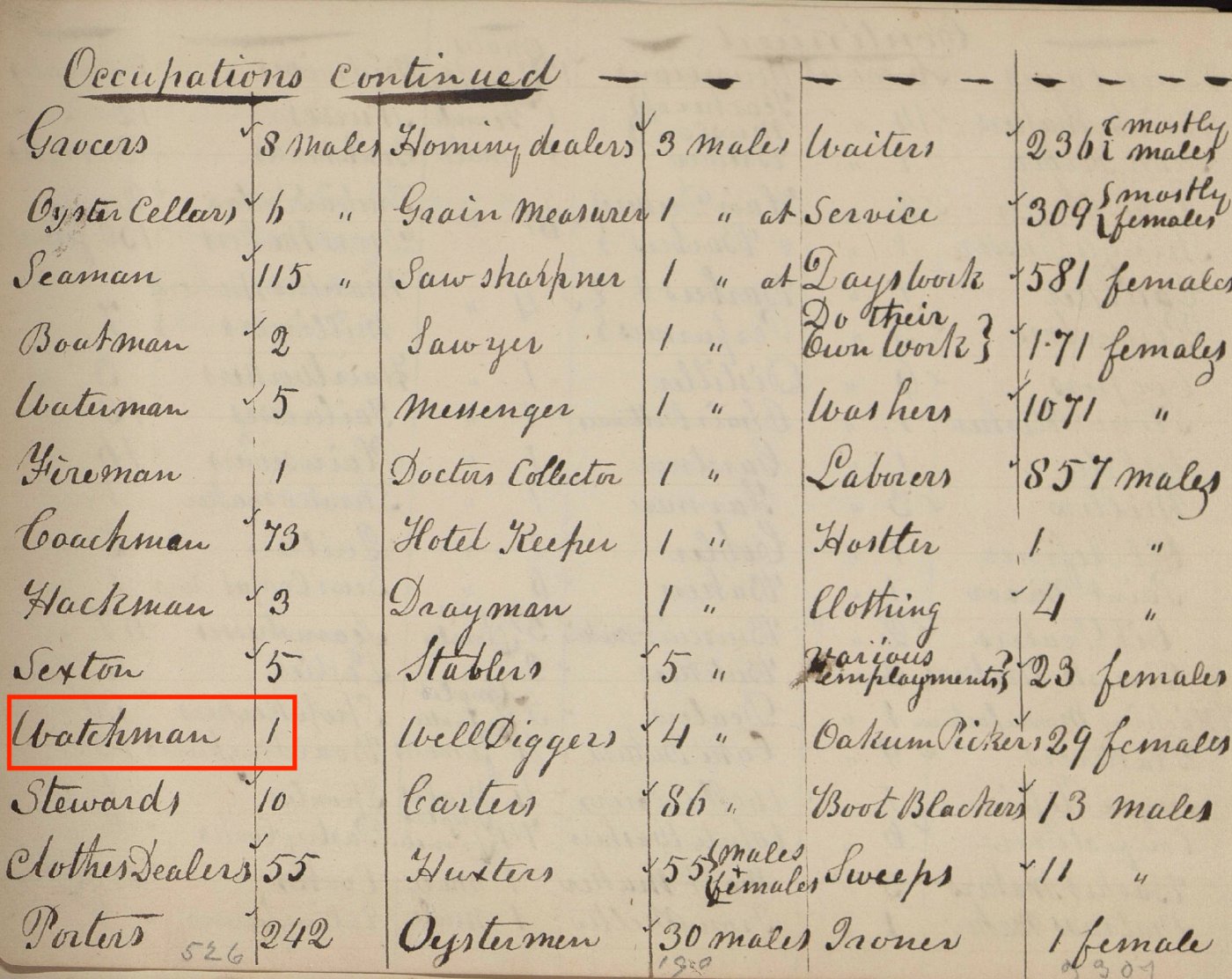
Black Philadelphians were excluded from serving in the police force until 1884. Despite this the 1838 Analysis of Census Facts of the Free Black Population indicates that there was one person serving as a ‘watchman’.
Black men fought in the Revolutionary War and the War of 1812, but subsequently faced exclusion after those wars from military service until the Civil War; a period of almost 60 years.
Meanwhile, municipal authorities, the watchmen and then the police, and the military guards, repeatedly demonstrated during the mob attacks that the Black community could not depend on them for immediate protection. They often ignored early calls to provide protection and arrived on scene after damage had been done. In their inability to act, people were killed, homes were destroyed, churches and public buildings were threatened or burned, people were beaten, and entire neighborhoods were terrorized.
Black Philadelphians therefore established their own systems of protection. We’ve generally understood Philadelphia’s Black vigilance committees through two particularly important periods.
1830-1840s: The first was the Vigilance or Vigilant Committee organized beginning in 1837, when Black Philadelphians helped people who had escaped enslavement navigate dangerous territory, find assistance, and establish new lives in freedom.
1850s-1860s: The second is the better-known Vigilance Committee work of the early 1850s, closely associated with William Still and documented in his book The Underground Rail Road.
These organizations are central to the history of emancipation and freedom in America.
But the newspapers analysis from our database suggests a much broader landscape.
Besides the famous committees mentioned above, there appear to have been multiple ‘vigilance’ committees and organizations, formed at different times and for different purposes. Some were organized to support people who had been arrested or imprisoned, including those caught up in the aftermath of the Christiana Resistance. Others operated as organized self-defense groups, some with structures that resembled military organizations.
Not all used the word vigilance, but their activities reveal a consistent pattern of Black community protection and organized self-defense.
We have already explored some of these strategies in our research on the mob attacks, including our video series, and a dashboard documenting the ways Black Philadelphians defended themselves and their communities.
The database is now helping us understand the volume of organizations that existed.
What follows is a roundup of the vigilance committees and self-defense organizations emerging from our research: why they formed, who participated, what they did, and how they contributed to the protection of Black Philadelphia.
The Organizations
Protecting Bodies Buried in Washington Square (late 1790s)
Early in the century, the Black community policed the Black burying ground in Washington Square (also called Potter’s field) against body snatchers.
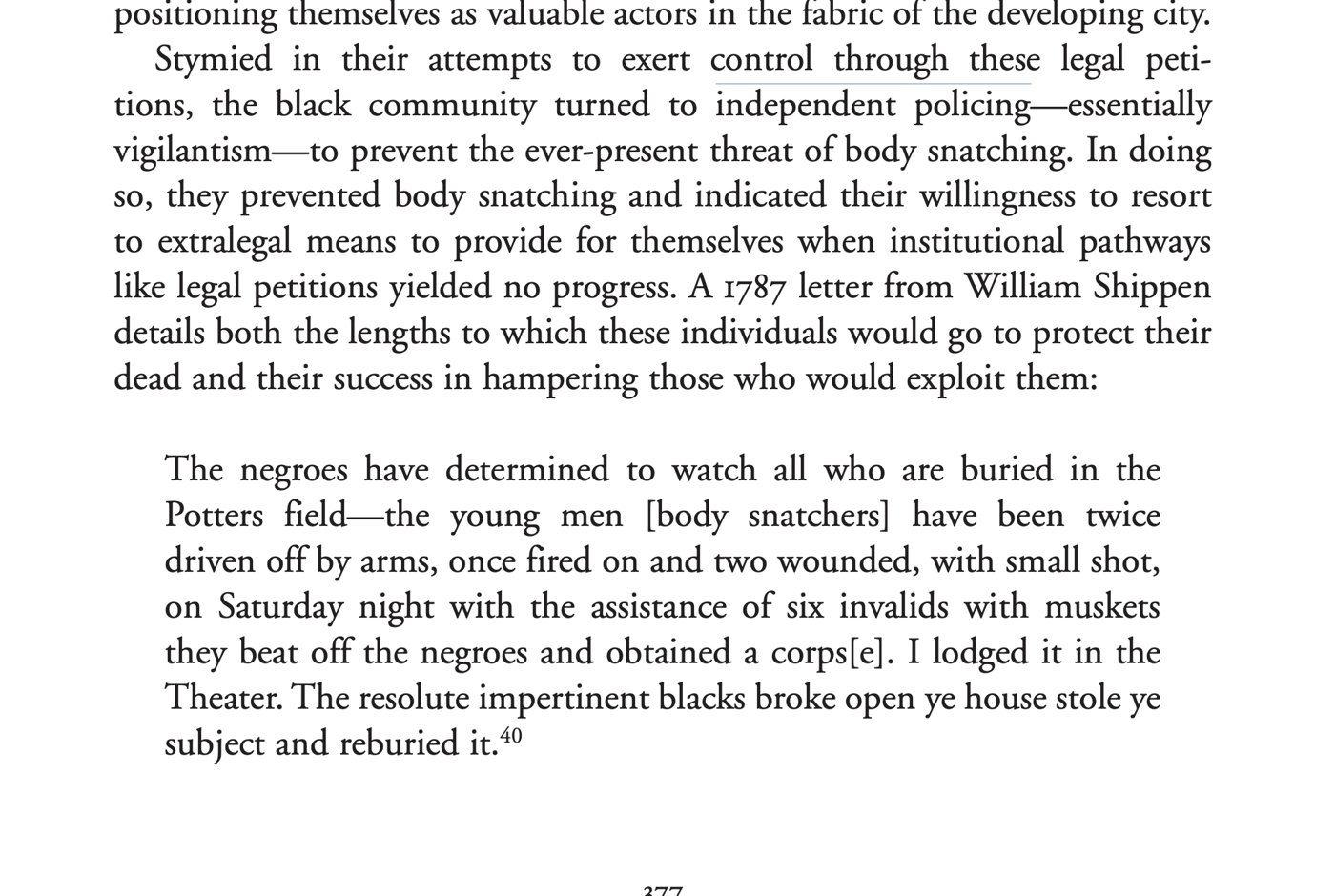
The author describes that when bodies were stolen from Washington Square in the late 1700s, armed Black men broke into where the bodies were stored, took them back and reburied them. Those people are probably still buried in Washington Square.
Vigilant Committee to Suppress Crime (1822)
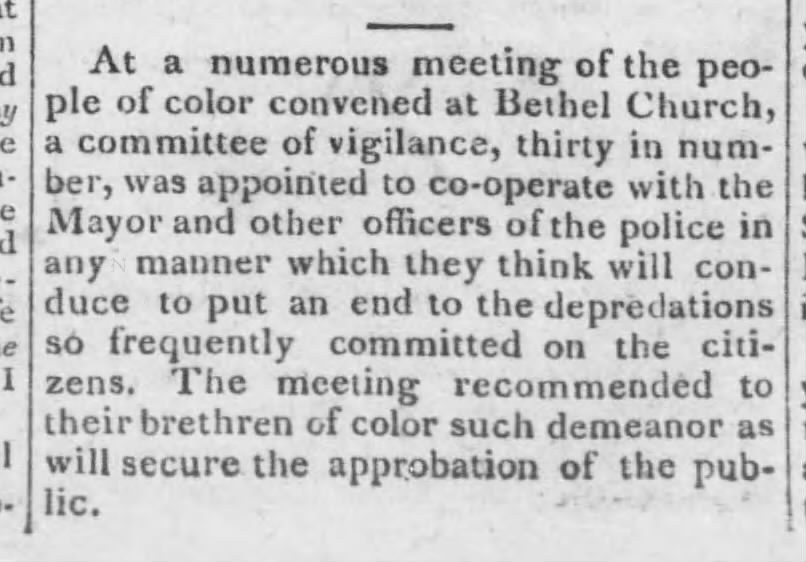
In 1822 Black Philadelphians formed an anti-crime, law-and-order committee, with Richard Allen as chairman and Russell Parrott as secretary (Poulson’s American Daily Advertiser, March 2, 1822). The article mentions ‘depredations’ committed on the citizens. Its not clear if the Mayor was suggesting that Black Philadelphians were the perpetuators or receivers of these depredations. The Philadelphia Inquirer reported it as a committee of vigilance, thirty in number, appointed at a numerous meeting at Bethel Church to co-operate with the Mayor and police. It was a different body from the later vigilance committees that aided people escaping slavery.
Committee of Vigilance against kidnapping (1827)
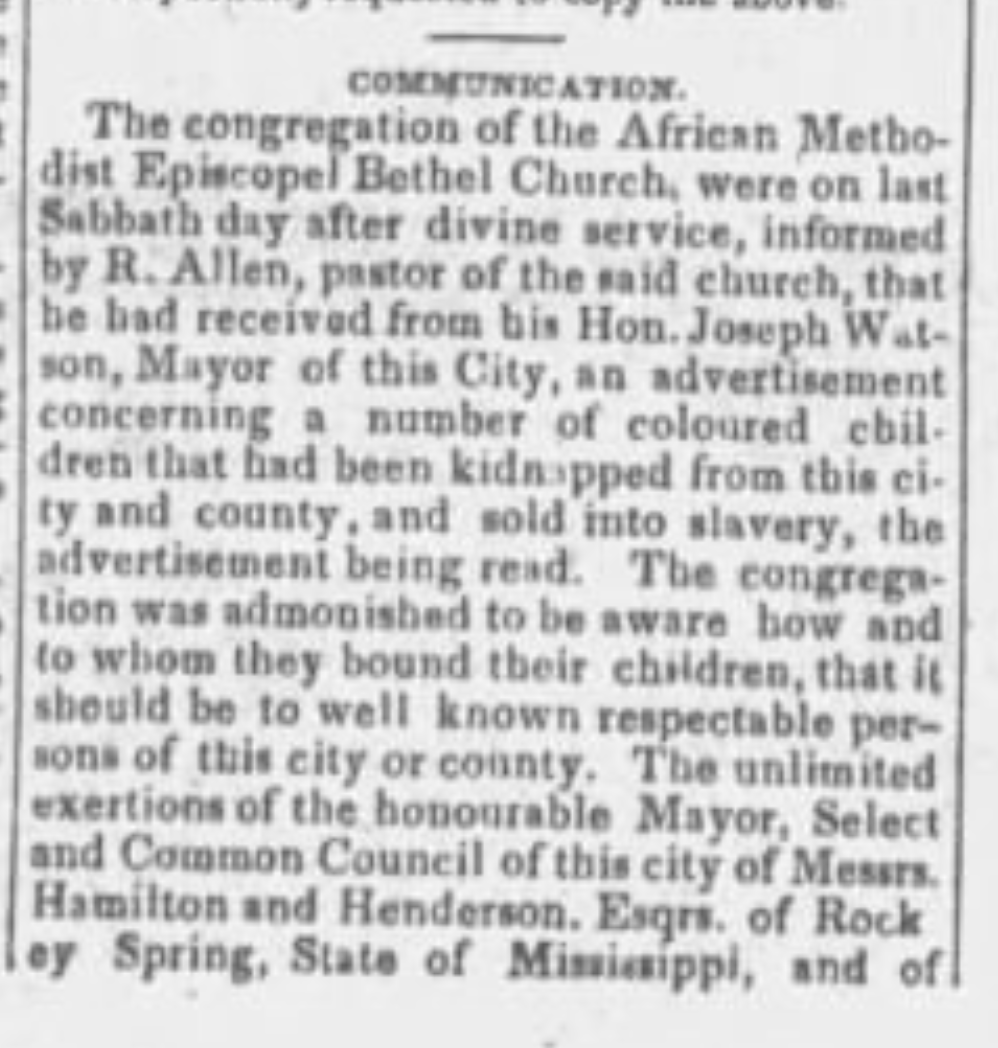
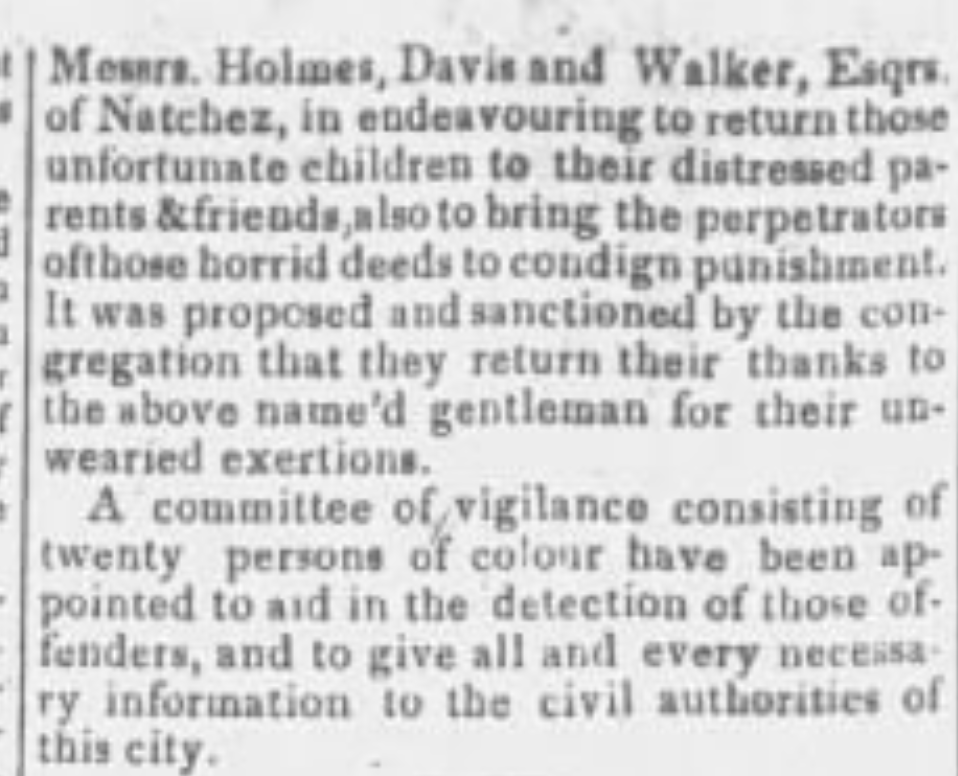
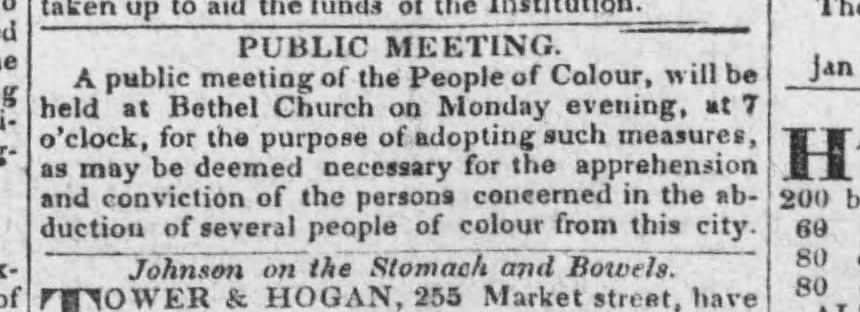
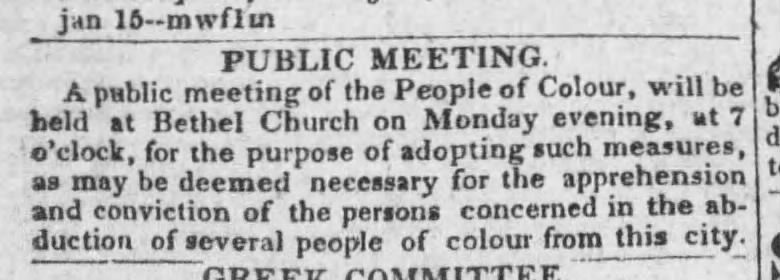
In February 1827, Richard Allen read his Bethel congregation Mayor Joseph Watson’s notice about Philadelphia children who had been kidnapped and sold into slavery in the South. The congregation appointed ‘a committee of vigilance consisting of twenty persons of colour... to aid in the detection of those offenders, and to give all and every necessary information to the civil authorities of this city.’ The twenty members are not named.
Protecting Society of the City and County of Philadelphia (1827)
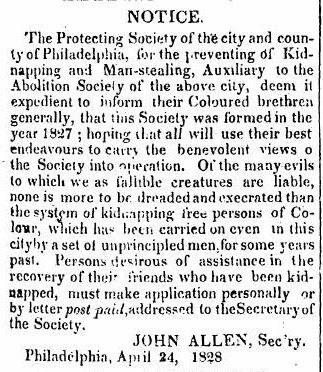
The Protecting Society of the City and County of Philadelphia for the preventing of Kidnapping and Man-stealing was formed in 1827 as an auxiliary to the Pennsylvania Abolition Society. Its notices began appearing in Freedom’s Journal in April 1828, signed by its secretary, John Allen (possibly Richard Allen’s son). Its notice asked anyone seeking help to recover friends who had been kidnapped to apply to the secretary in person or by letter.
Vigilant Committee of Philadelphia (1837)
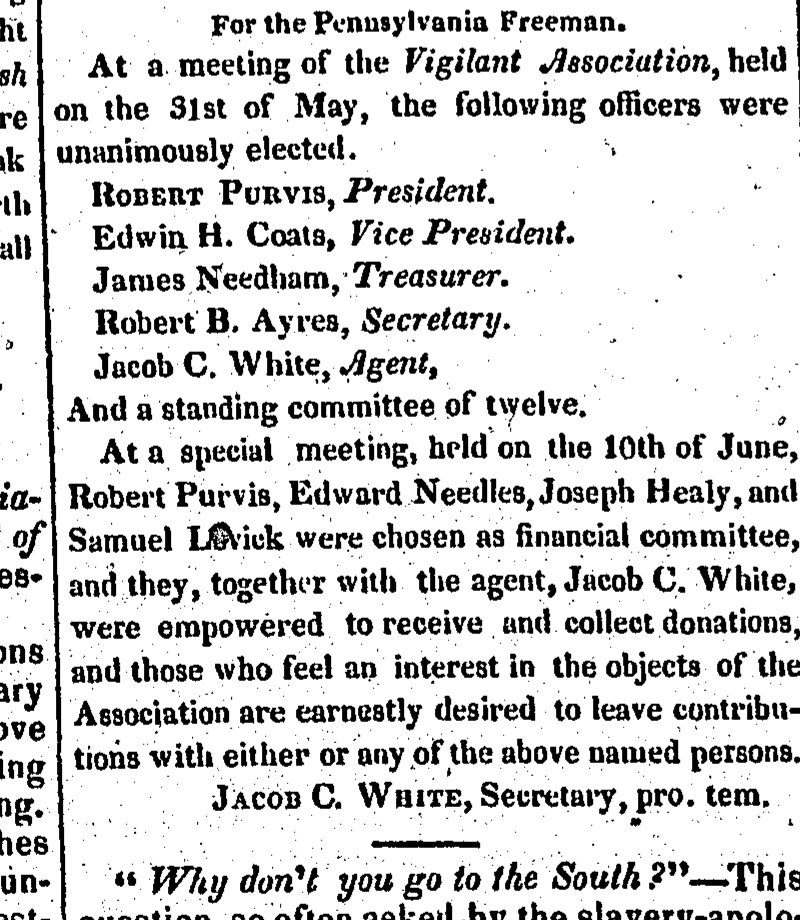
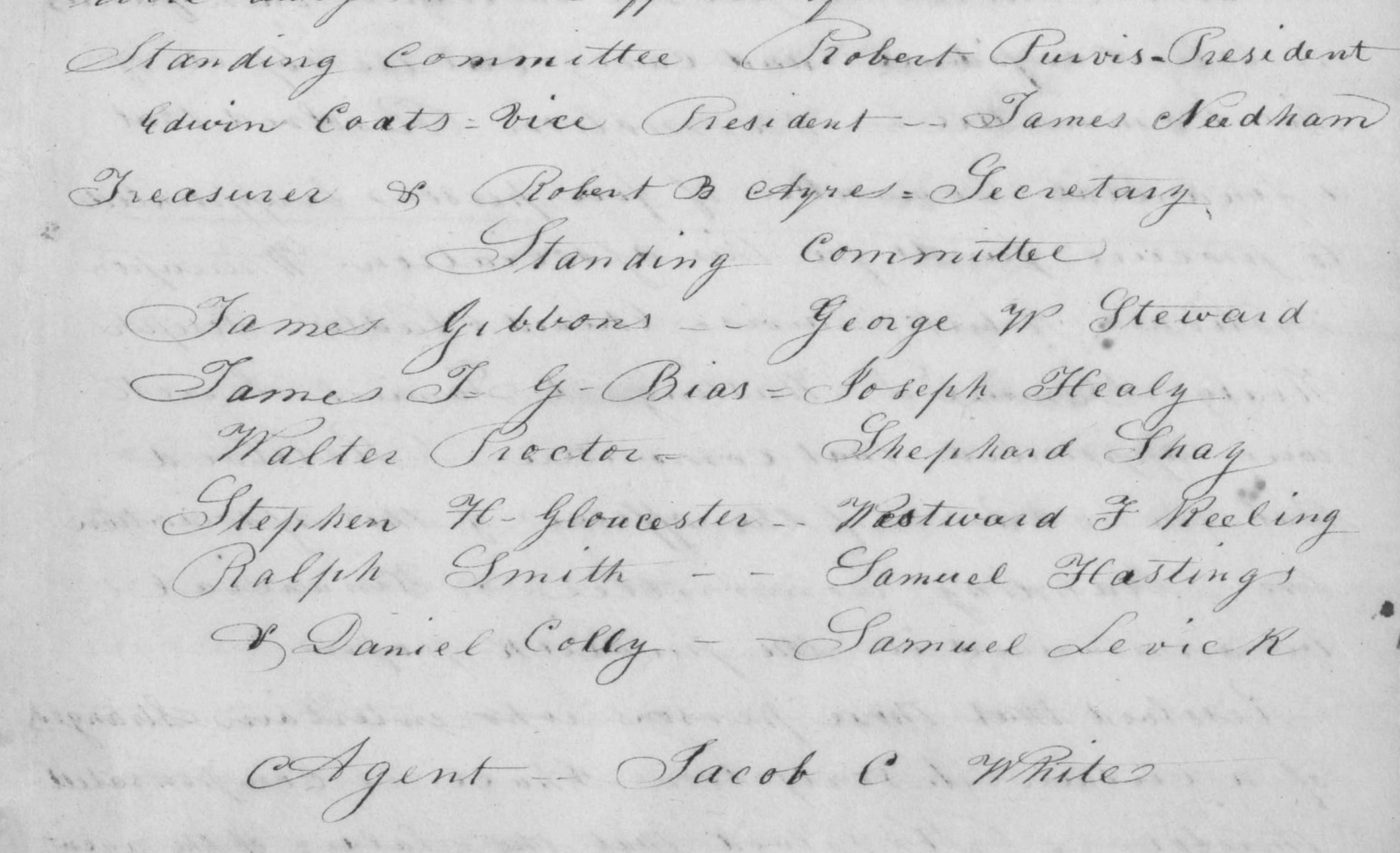
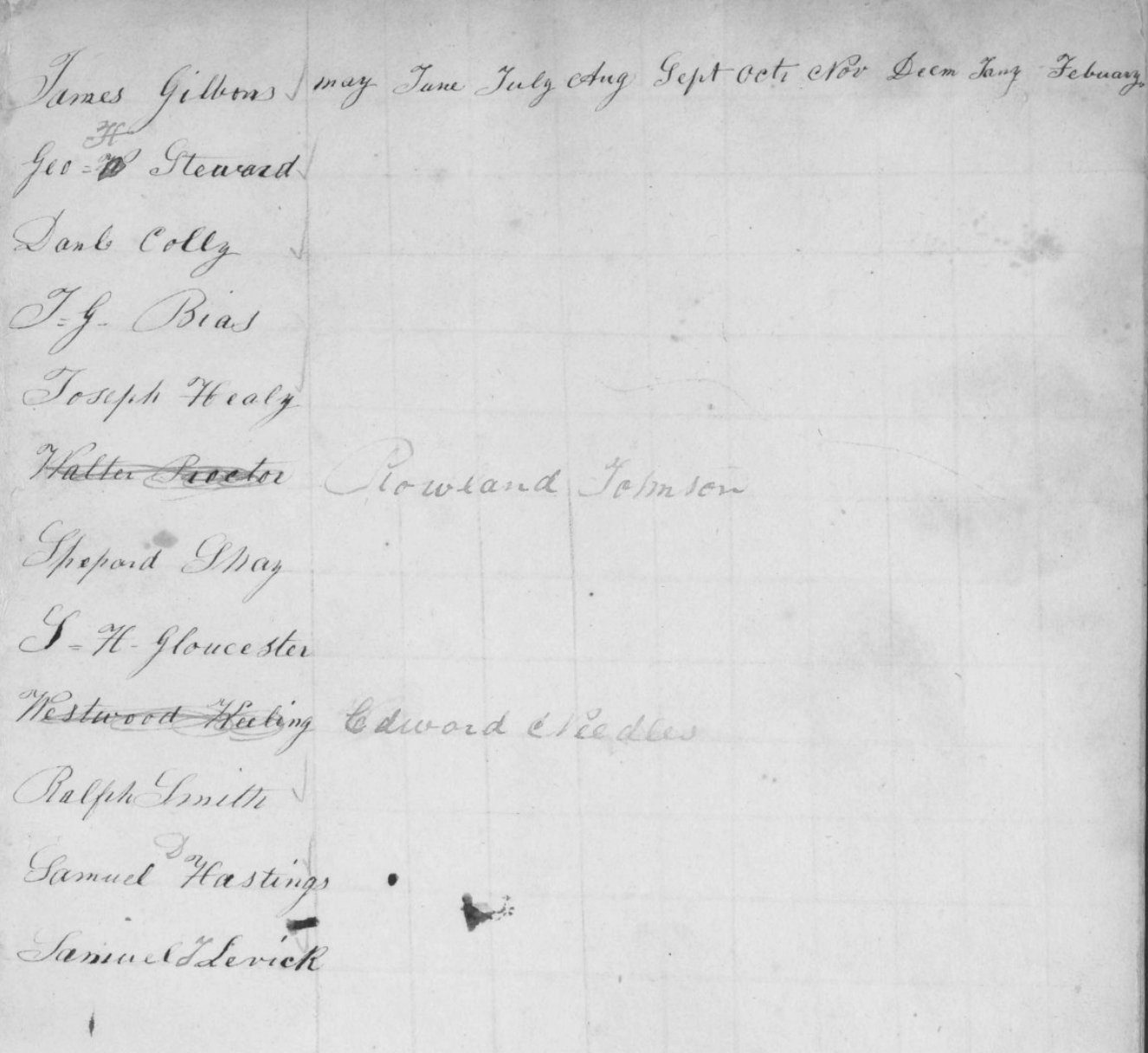
Founded in 1837 to aid people escaping slavery, it was called both the Vigilance Committee and the Vigilance Association. The committee provided people who were self-emancipating with immediate medical care, financial support, transportation, security and help finding work, assisting hundreds of people seeking freedom. Its records survive in the Vigilant Committee of Philadelphia Records (Am .3375), Leon Gardiner Collection, Historical Society of Pennsylvania. See the digitized minute book: https://online.flippingbook.com/view/485219936/26-27/
Female Vigilant Committee (1838)
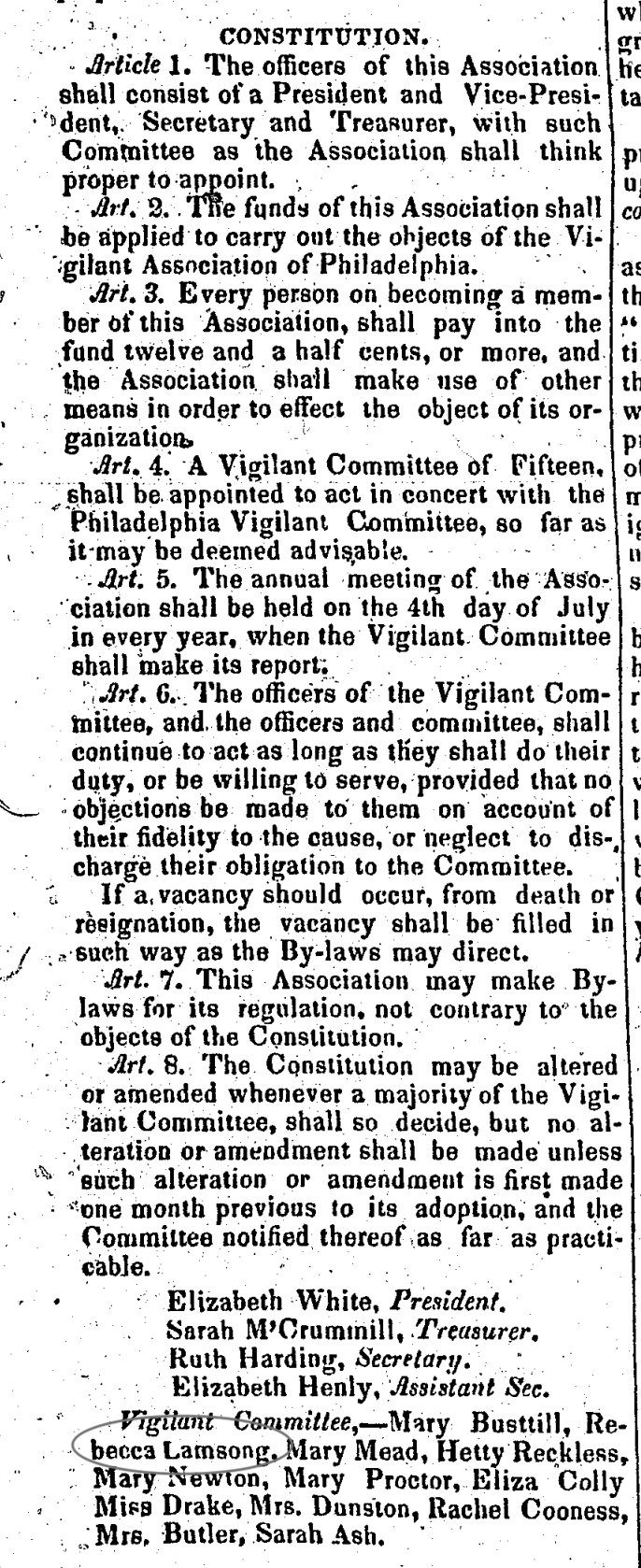
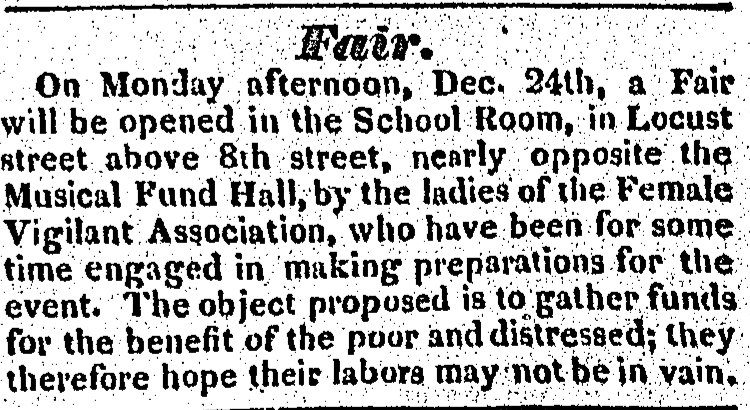
The Female Vigilant Association of Philadelphia was founded in 1838. Its constitution directed its funds to carrying out the objects of the Vigilant Association of Philadelphia, and its own Vigilant Committee of Fifteen was to act in concert with the Philadelphia Vigilant Committee (Pennsylvania Freeman, July 5, 1838). It raised money and aid alongside the men’s committee while remaining its own organization. Its Christmas fair opened Monday, December 24, 1838 in the School Room on Locust Street above 8th, opposite the Musical Fund Hall, to gather funds for the poor and distressed (Pennsylvania Freeman, December 20, 1838).
Special Vigilance Committee (1851)
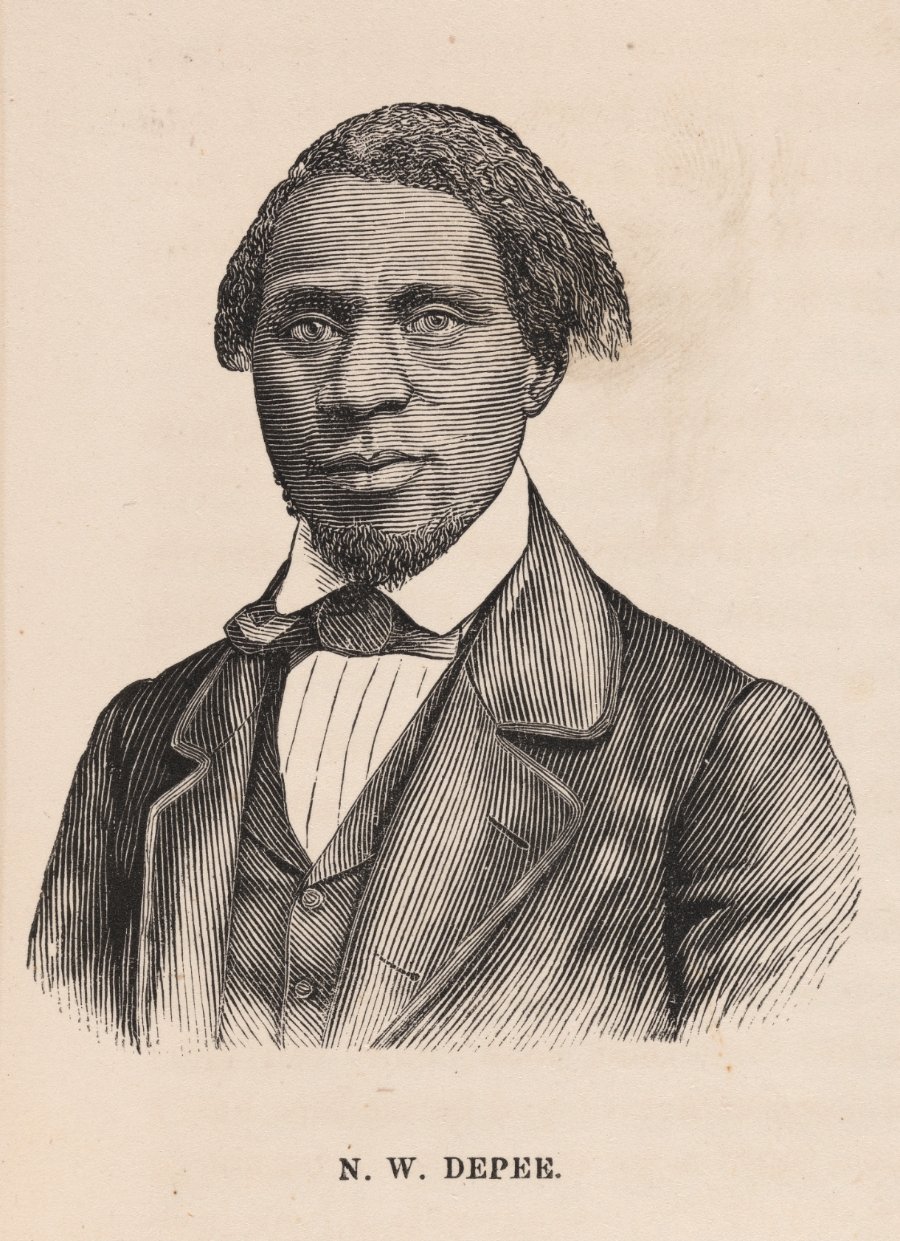
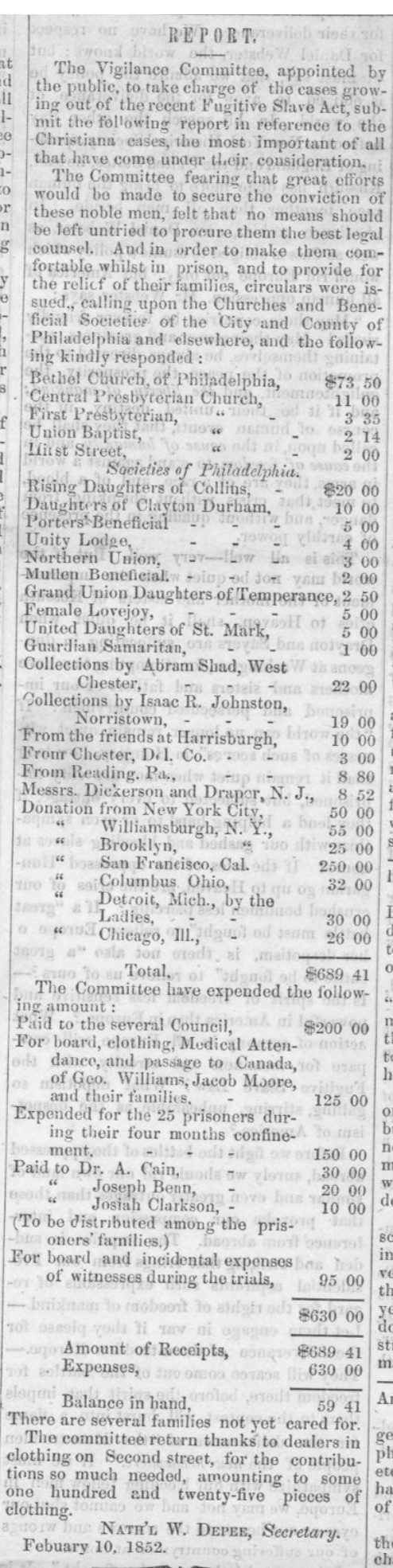
Formed in late 1851, after the Christiana resistance, to aid people escaping slavery (Frederick Douglass’ Paper, November 13, 1851; Voice of the Fugitive, January 15 and February 12, 1852). Its report on the Christiana cases, signed by its secretary, Nath’l W. Depee, on February 10, 1852, and printed in Frederick Douglass’ Paper on March 4, 1852, shows the committee hiring legal counsel for the Christiana defendants, supporting the 25 prisoners through four months in jail, aiding their families, sending George Williams and Jacob Moore and their families to Canada, and boarding the witnesses during the trials. It raised $689.41 from Philadelphia churches, beneficial societies, and donors as far away as San Francisco.
Vigilance Committee (1852)
This committee did the same work as the 1837 committee on a much larger scale, helping thousands of people seeking freedom. Its work is documented in William Still’s landmark book, The Underground Rail Road (1872). Harriet Tubman relied on the vigilance committee for support with people newly arrived in Philadelphia. This work is highlighted in the movie Harriet.
Frank Johnson Guards (1859)
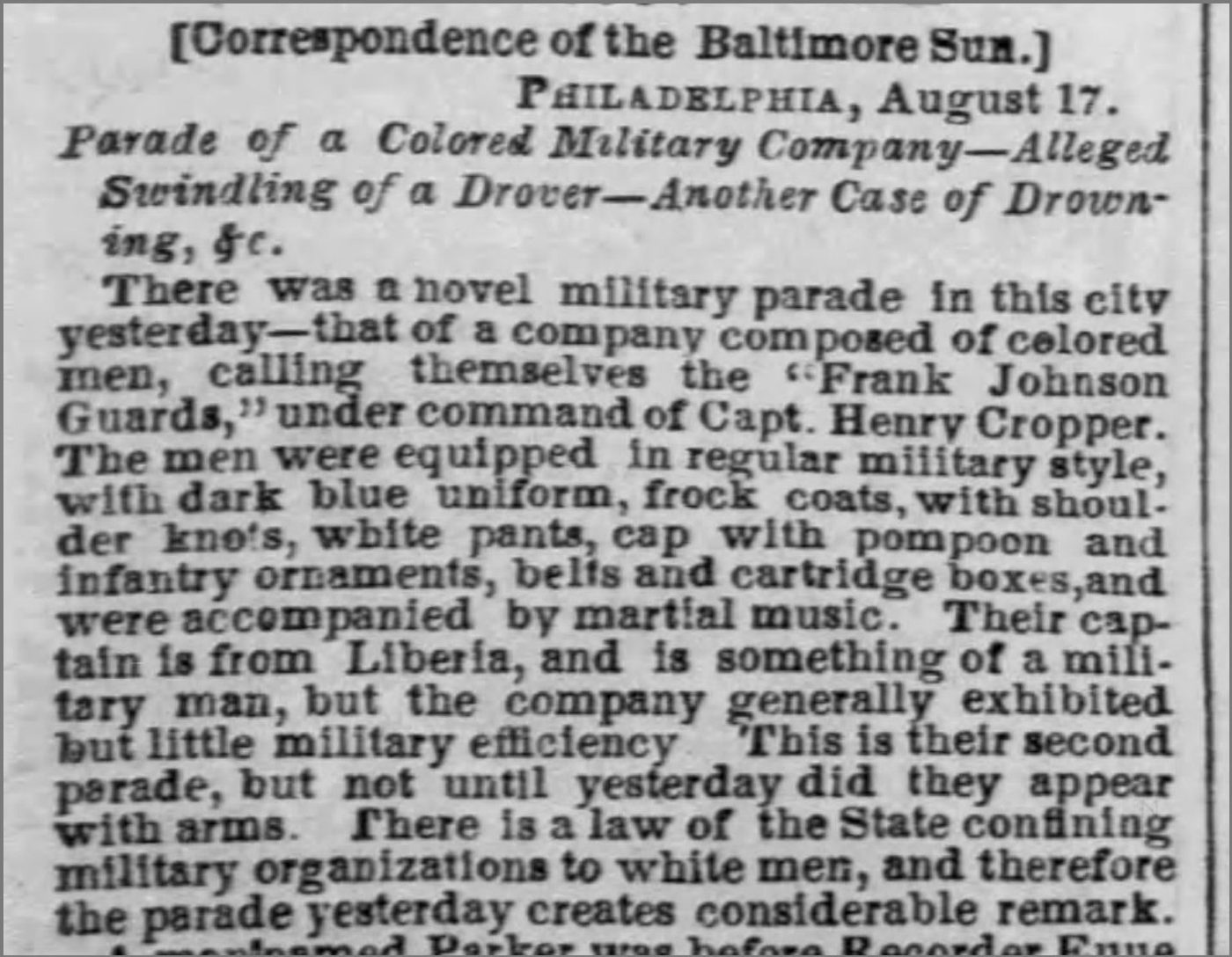
A Black militia company in Philadelphia. On August 16, 1859, under Capt. Henry Cropper, ‘from Liberia,’ the Guards paraded through the city in dark blue uniforms with white pants, belts and cartridge boxes, accompanied by martial music. It was their second parade but the first with arms. The Baltimore Sun’s Philadelphia correspondent noted that ‘There is a law of the State confining military organizations to white men, and therefore the parade yesterday creates considerable remark’ (August 18, 1859). See also our post on Samuel Williams: our Samuel Williams post
Williams Assembly (1865)
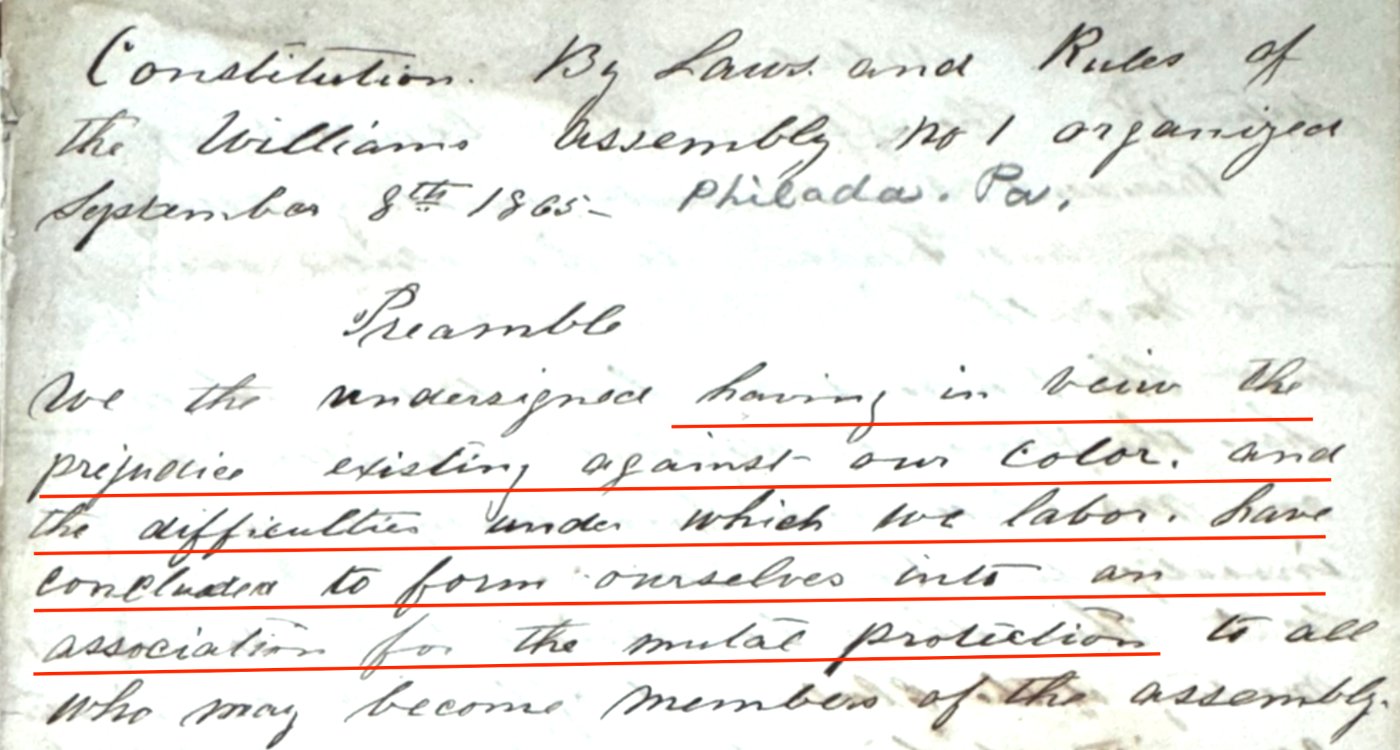
Founded in 1865 by Samuel Williams specifically for protection. Its constitution speaks of ‘protection’ in response to ‘prejudice’. Most beneficial societies form for ‘mutual relief’, not for protection, which makes this group unusual.
“We the undersigned having in view the prejudices existing against our color and the difficulties under which we labor have concluded to form ourselves into an association for mutual protection” - Constitution of the Williams Assembly
The founder, Samuel Williams, was connected to Black self-protection groups in Christiana and an Underground Railroad agent. Members were barred from gambling, profanity and public drunkenness, and the Assembly had a Marshall and bought badges, at a time when no Black man could join the Philadelphia police (the first, William Dicks, joined in 1884). See our post on Samuel Williams.
What This Tells Us
Black self-protection in Philadelphia was not a single moment or a single committee. It was ongoing, from the men guarding the Potters field in the 1790s to an armed militia company parading through the city in 1859.
And what we are seeing is only what rose to the top. These organizations surface in brief newspaper notices, a meeting announcement here, a treasurer’s report there. The twenty members of the 1827 committee are never named. Most of this work was meant to stay quiet, and much of it was never written down. If this many groups made it into print, there were almost certainly more.
When the city would not protect them, Black Philadelphians rose to the occasion. They protected their own neighborhoods, and they protected the Black people passing through Philadelphia on the way to freedom.
The organizations also changed over time. In 1822 and 1827, committees formed at Bethel offered to work alongside the Mayor and the civil authorities. By the late 1830s, the Vigilant Committee was acting outside the law to shelter people escaping slavery. After 1850, the Special Vigilance Committee was paying lawyers and supporting prisoners charged with treason after Christiana. And by 1859, on the eve of the Civil War, the Frank Johnson Guards were marching with arms in defiance of a state law that reserved military organizations for white men.
Nobody stood down. We will keep adding to the database as more of these organizations come to light.
Sources
Newspapers and periodicals
- Poulson’s American Daily Advertiser, March 2, 1822.
- Philadelphia Inquirer, March 6, 1822, p. 2. Newspapers.com
- Philadelphia Inquirer, February 3, 1827, p. 2, and February 5, 1827, p. 3.
- United States Gazette, February 23, 1827, p. 4.
- Freedom’s Journal, April 1828; May 16, 1828, p. 7.
- Pennsylvania Freeman, July 5, 1838; December 20, 1838, p. 3; June 20, 1839, p. 2. Center for Research Libraries.
- Frederick Douglass’ Paper, November 13, 1851; March 4, 1852, p. 1. Courtesy New York Heritage Digital Collections, St. John Fisher University.
- Voice of the Fugitive, January 15 and February 12, 1852.
- The Baltimore Sun, August 18, 1859, p. 4.
Archives
- Vigilant Committee of Philadelphia Records (Am .3375), Leon Gardiner Collection, Historical Society of Pennsylvania. Digitized minute book
- Pennsylvania Abolition Society, 1838 and 1847 censuses of the free Black population of Philadelphia, Historical Society of Pennsylvania.
- “Committee to visit the Colored People,” analysis of census facts collected by Benjamin C. Bacon and Charles Gardner [AmS .134] 1838. Historical Society of Pennsylvania. Pennsylvania Abolition Society papers [0490].
- Williams Assembly Constitution, courtesy the Dorsey Collection, Cheyney University.
Books, articles and other sources
- Jubilee Marshall, “Race, Death, and Public Health in Early Philadelphia, 1750–1793,” Pennsylvania History: A Journal of Mid-Atlantic Studies 87, no. 2 (Spring 2020): 364–389. Penn State University Press. Quoted p. 377, from a 1787 letter by William Shippen.
- William Still, The Underground Rail Road (Philadelphia, 1872).
- Research references shared by historian Julie Winch.
- Merriam-Webster, “vigilante”.
- Harriet, directed by Kasi Lemmons (Focus Features, 2019).
- 1838 Black Metropolis, names database, mob attacks dashboard and Samuel Williams post.